Preconstruction
What Your Closeout Should Tell Your Next Bid
The estimate is the margin you priced. Closeout is where you find out the margin the job closed at. Most companies never put those two numbers in the same room. Here is what closeout knows that the next bid needs.

The estimate is the margin you priced. Closeout is where you find out the margin the job closed at.
Most companies never put those two numbers in the same room.
The gap between them is not small. Across 18,229 projects, AIA Contract Documents found changes averaging 4.4 to 4.6% of project cost, with most change orders landing in the second half of the job. CFMA puts net margin for a commercial general contractor at 4.4%. On a typical job, the changes settled at the end are the same size as the profit.
So the closing job knows something the next bid needs to hear. The question is whether anyone tells it.
Why the lesson never makes it back
By the time a job closes, the estimator who priced it is three pursuits further on. The project executive closing it out is not in the next bid review. The closeout file goes to the archive, organized for the owner: O&Ms, warranties, as-builts, lien waivers. It answers "did we hand over the documents?" It does not answer "what did this job teach us about pricing the next one?"
The lessons learned meeting is supposed to close that loop. In practice it happens months later, when memories are soft and the people who knew the details have moved on. What comes out is a list of feelings: the architect was slow, the drywall sub was tough, the owner was difficult. None of it changes a number.
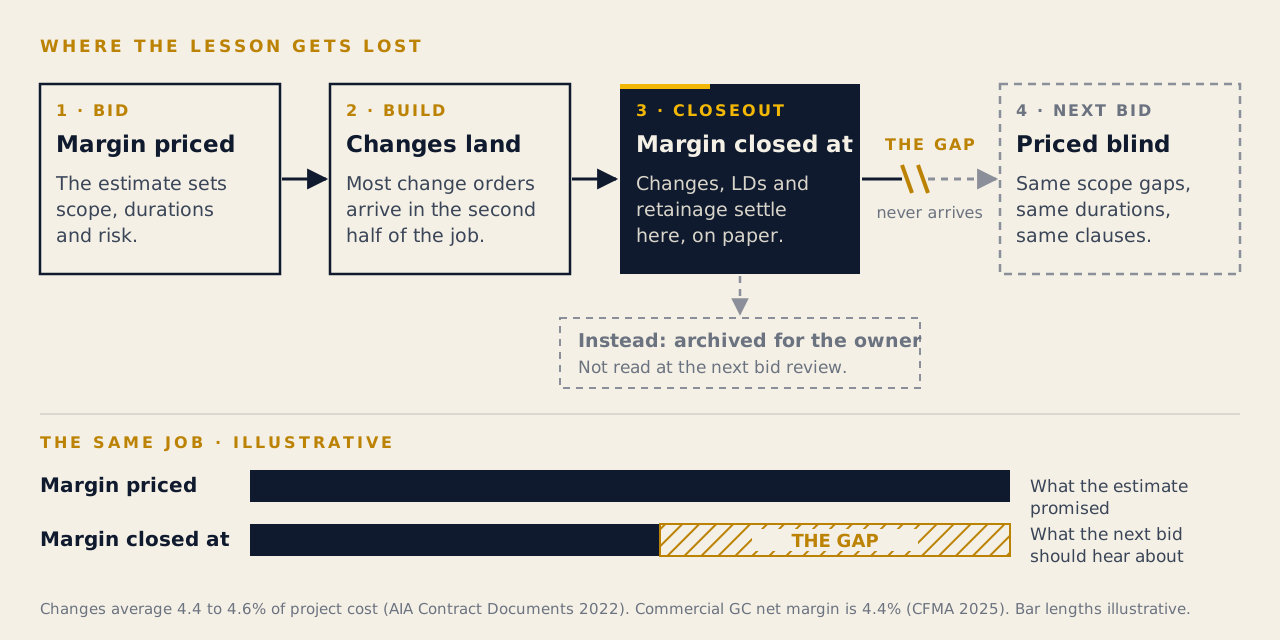 Where the lesson gets lost: closeout settles the margin the job closed at, then the file is archived for the owner and the next bid is priced without it.
Five things closeout knows that the next bid needs
1. Where scope fell between trades. Every change order has a reason. Some were owner changes. Many were gaps: work that two trades each assumed the other was carrying. Closeout is the only point where all of them are visible together. That list belongs in your trade scope sheets and your bid leveling, so the next estimate assigns the scope before award instead of paying for it after.
2. Which clauses cost money. The notice window that was missed. The liquidated damages that were assessed. The supplementary condition that moved a responsibility onto the contractor. The retainage terms that held money for months after the work was done. Contract administration, not workmanship, sits behind the top causes of construction disputes in Arcadis's global study. The clauses that cost you on the last job are the clauses to price, qualify or push back on in the next one.
3. How long reviews and approvals really took. Submittal review rounds. RFI turnaround. Time from substantial completion to final payment. The schedule assumed a number for each. Closeout has the actual number. If shop drawings went three rounds, the next schedule and the next general conditions should carry three rounds.
4. What punch and closeout actually cost. Recurring punch items by trade. Weeks from substantial completion to closeout. Staff kept on the job to chase paperwork. Days retainage stayed with the owner. Most estimates carry closeout as a thin allowance. The record shows what it really took.
5. Which subcontractors held their number. Sub change orders, backcharges, late submittals, punch items that sat open. The bid that was lowest on bid day is not always the lowest at closeout. Leveling the next bid without that history means choosing on half the facts.
| Closeout finding | What it changes in the next bid |
|---|---|
| Changes from scope gaps between trades | Trade scope sheets and bid leveling |
| Missed notices, assessed LDs, retainage terms | Bid risk review: price it, qualify it or exclude it |
| Actual submittal and RFI turnaround | Schedule durations and general conditions |
| Real punch and closeout effort | Closeout allowance and staffing |
| Sub change orders and backcharges | Sub selection and leveling |
Make it a record, not a meeting
The loop closes when the lessons are kept the same way the money was decided: on paper, with a source.
Tie every lesson to the page that proves it. "The drywall sub was tough" gets argued away on bid day. "Eleven change orders for framing scope the drywall sub excluded, CO 14 through CO 24" changes the leveling sheet. Without the source, a lesson is an opinion.
Use the same structure on every job. If each closeout records scope gaps, costly clauses, actual durations, closeout effort and sub performance the same way, the third job can be compared with the first. That is when patterns show up.
Capture it while the job closes. The evidence is all in front of the team during closeout: the pay applications, the change log, the correspondence, the punch list. Six months later it is in an archive and nobody opens it.
File it where the estimator works. Next to the cost history and the trade scopes, not inside the closeout binder. A lesson the estimator has to go looking for will not be read at 4pm on bid day.
One question for your next bid review
At the final review, ask: on our last three jobs like this one, where did the margin go between the bid and the closeout?
If someone can answer with documents in ten minutes, the loop is working. If the answer is a story, the next job will teach the same lesson again, at the same price.
Where Halozen sits
Halozen's closeout review reads the contract and the project record and builds a register: every requirement that affects final payment, the evidence against it, what is still open, each line cited to the page. The customer keeps it. Done project by project, it becomes the record the next bid reads from. Your team still decides what to price and what to qualify. That judgment stays where it belongs.
Common questions
What should a closeout feed back into estimating?
Where scope fell between trades, which contract clauses cost money, how long reviews and approvals really took, what punch and closeout actually cost, and which subcontractors held their number. Each one changes a line in the next estimate.
Why don't lessons learned meetings fix this?
They usually happen months after the job, after the estimator has moved on, and they produce opinions instead of evidence. A lesson tied to the change order, RFI or clause that proves it survives bid day. A lesson from memory gets argued away.
Who should own the loop between closeout and precon?
The project team captures it while the job closes, and the estimator reads it at the bid review. The record has to sit where the estimator works, next to the cost history and trade scopes, not in the closeout binder.
Start the record on one closing project.
Upload the contract and the record you have, privately. The register comes back in two weeks: every requirement that affects final payment, its evidence and what is still open, each line cited to the page. It is yours to keep, and it is where the next bid starts.